2008년 10월 31일 금요일

Creating your Custom Search Engine just got easier


On Sunday morning I had the pleasure of attending my colleague Ben Bunnell's session at ALA: Google Presents: New Developments. He talked about the addition of metadata records to Book Search results and other new features and updates for tools like News Archive Search and Google Patent Search. But he was especially excited to talk about Google Custom Search Engine (CSE), which makes it easy for anyone to create their own customized search engine. It turns out the CSE team just released a bit of code to make it even easier.

Let's say you've created a customized library website where you've spent years (literally) compiling links to specific resources that are useful to your community. To take advantage of your knowledge and expertise -- your "filter" for the web -- people regularly search your site and click on the useful links. Now imagine offering your fellow librarians or patrons a custom search engine built from the resources you've painstakingly collected -- without having to build it manually, URL by URL.

That's what the Custom Search team's new 'on the fly' feature lets you do. You no longer have to manually indicate which websites you'd like people to be able to search. Instead, you can embed a piece of code in your web page that automatically creates a CSE from the links on the page. And it's automatically updated, so if you add new links to your collection, the content on those websites will also be added to your search engine.

What will your search results look like? Here's an example, courtesy of our Custom Search blog: check out the abundance of Artificial Intelligence-related links on this Berkeley page, then see the results from the query "planning" using a CSE created for that page 'on the fly.'

If you have a website with links to specialized resources you want to share with people, go ahead and give it a try -- and pass the word along!


It's for a test: This post is crawled from http://librariancentral.blogspot.com/2007/06/creating-your-custom-search-engine-just.html (Mon Jun 25 14:47:00 2007).

osho travel toothbrush

Osho_travel


Available in five bright colours, the OSHO Presto is the latest in the range of OHSO travel toothbrushes.


(via ianclaridge)


It's for a test: This post is crawled from http://www.swiss-miss.com/weblog/2008/10/osho-travel-too.html (Mon Oct 27 14:37:12 2008).

癮科學:替代能源 -- 核能


在全球暖化意識日漸高漲的今天,尋求替代能源來取代汙染極高的火力發電廠已經是刻不容緩的事了。小薑準備花幾個禮拜的時間,介紹幾種可能的替代能源的發展現況、限制,與台灣的適用度。有些資料可能大家都已經知道,有些可能大家都不知道,也有些可能帶有爭議性,但對小薑來說,只要能讓大家對各種可能的替代能源有所認識,能有助於台灣早日擺脫火力發電,那就算成功了 ^^。

核能發電脫胎自二次大戰時對核裂變的研究。「核裂變」是當重原子(通常是鈾或鈽)被中子撞擊時,會裂成兩(或更多)半,同時放出大量的能量,再加上額外的中子。這些放出來的中子,會再撞擊其他的鈾或鈽原子,產生所謂的「連鎖反應」。在炸彈裡,連鎖反應不被控制(所以就卡碰了),但在核能反應爐裡會有吸收中子的「控制棒」,控制自由中子的量,繼而將反應控制在一個安全的範圍內。放出來的能量由某重熱交換液體(像液態鈉)以熱的形式帶到發電廠的另一個部份,加熱水產生蒸汽,再推動渦輪產生電力。

繼續閱讀全文癮科學:替代能源 -- 核能


It's for a test: This post is crawled from http://chinese.engadget.com/2008/10/31/alternative-power-sources-nuclear/ (Fri Oct 31 05:00:00 2008).

2008년 10월 30일 목요일

Love girls~ :)


So cute~!

2008년 10월 29일 수요일

Wonder, Wonder, Wonder....!!!


I love these girls...

2008년 10월 24일 금요일

Writing, Briefly

Some insight into how Paul writes

Ad: "Hackers & Painters" by Paul Graham


It's for a test: This post is crawled from http://www.paulgraham.com/writing44.html (Fri Aug 5 16:38:41 2005).

Firefox Extension to Browse As If You Were in China

China Channel offers a Firefox extension for those outside of China mainland that aims to let you experience the web – and the Chinese web censorship – as if you were within China. Not sure how well this works at all times (for instance, I heard that sometimes different locations within China show different blocks). When I installed the China Channel add-on and then searched Google.com for falun gong, I received a “connection interrupted” instead of the Google result page – without any doing of Google, I suppose, but based on the URL’s parameter with functionality coming from the Chinese Ministry of Information.

[Thanks Markus Renschler!]

[By Philipp Lenssen | Origin: Firefox Extension to Browse As If You Were in ... | Comments]


[Advertisement] Google books at eBay: background info on Google, AdWords, AdSense, Blogger and more...


It's for a test: This post is crawled from http://blogoscoped.com/archive/2008-10-27-n83.html (Mon Oct 27 10:09:14 2008).

2008년 10월 17일 금요일

Tips on Finding Your Blogging Rhythm


Today I had this question from a reader about their struggle with posting daily on their blog:


“Darren I am a new blogger and I really want to be posting every day, but I just can’t keep up. I find it takes me so long to put each post together that to do 7 a week would take me 7-10 hours (I am writing ‘how to’ type posts). While I’d love to dedicate that much time to blogging each week I have a full time job, family and social life to keep up. Do you have any tips?”


This is a great question and one that I know a lot of bloggers struggle with - particularly in their early days.


Finding a posting rhythm is important to do - but it doesn’t just happen. In this post (and the next one tomorrow) I want to make a few comments that may assist in the finding of your posting stride.


1. There is no Right Posting Level


One of the common misconceptions that new bloggers have is that they are somehow failing as a blogger if they don’t get a post up every single day.


The reality is that there is no posting schedule that is right for all blogs. For some blogs a post a day is just right, for others posting 20 times a day is ideal, for others it is one or two posts a week. The ideal post frequency for your blog will depend upon many factors including:


  • Your topic (how wide the niche is, how much news there is on the topic etc)


  • Your post style (for example posting tutorials can take longer than posting short ‘news’ posts)


  • Blogger time (how much time you have available for blogging)


  • Your audience (some blogs readers seem to love lots of short posts each day while others are after something more meaty)


  • How Many Bloggers You have (a blog with multiple authors can sustain a higher number of posts)


There is no optimal posting level for all blogs. Last time I surveyed ProBlogger readers on how many posts they published a week I found that on average they were doing 8.9. However, as you’ll see from the chart below (showing the spread of results from the poll) the most common answer was actually 5 posts a week.


Posts-Per-Week-1


2. Start out Slow and Work Your Way Up


My advice to new bloggers is to start out slower than what you’re aiming for, to work hard on quality of posts and then over time increase your posting frequency as you’re able.


This was the approach that I had with my photography blog. My initial goal was to post 3 quality posts per week (Monday, Wednesday and Friday). Once I had consistently met this goal for a month or so I added a 4th post into the schedule and then a month or so later a 5th.


At 5 posts per week (each weekday) I stopped increasing my posting frequency (I couldn’t sustain any more) until a reader actually came to me and offered to post a summary of the activity on the forums every Sunday. I then decided to make Saturday a ‘reader question’ type day where I simply started a discussion (a fairly easy post to write) and suddenly I was at 7 posts a week.


This process of getting up to daily posts took me over a year to achieve. In more recent times I’ve hired writers to take on 4 of the posts per week and have weaned myself off writing them all. This will enable me to concentrate on expanding other areas of the site in coming months.


The beauty of this gradual increase of posts was that I was able to work up to daily posting and not over stretch myself (or have quality of work suffer). The analogy I use to describe this is that when you’re training as an athlete for a long distance event, you don’t suddenly go out and start running the eventual distance you’ll run. You need to work up to that distance over time, get yourself in condition and get your body used to the distance. Too much too quickly can mean you burn out.


It also meant that there was no sudden change in posting frequency for my readers to have to deal with. I doubt any of them would really even notice the changes.


3. Monitor Your Readerships Response to Your Posting Levels


As you increase your posting levels pay careful attention to how your readership are responding.


What I’ve found is that there is generally a ’sweet spot’ where a blogs audience is most content. This sweet spot will vary from blog to blog.


Watch what your readers say about your posting level - but also look for other signals and signs that you might be posting too much (or not enough).


For example watch what happens to your traffic levels on days when you post more as opposed to days that you don’t post (or post less).


Another thing to watch is comment numbers. I find that if I post too much the numbers of comments on a post will decrease while if I only post once a day the comment numbers go up (conversely if I don’t post for a couple of days comment numbers slow on a post after a day or two signaling that my readership are done with the topic and want more).


4. Consistency is Important


What is probably more important than ‘how many’ posts you do a week is that you establish some kind of consistent posting rhythm that readers can expect to get from your blog. The only time I’ve ever had readers complain about how many posts I do on my blog is when I’ve suddenly changed things in one way or another.


For example there was a week a couple of years ago where I simply found myself with a lot to say and where there was a lot of breaking news on the niche of blogging. As a result my posting frequency here at ProBlogger leapt up from twice a day to 4-5 times a day. Readers pushed back because I’d been consistently producing 2 posts a day and suddenly they were needing to find time to digest double that.


The same thing can happen when you suddenly decrease your posting frequency - readers come to expect a certain level of posts and suddenly it is gone.


If you do make changes to your posting frequency consider doing them gradually and/or explaining what is going on to your readers.


4 More Tips Tomorrow - Have Your Say Now


This is just the first part in a two part series on finding your posting rhythm as a blogger. As I began to write this post I realized that there was a lot to cover so wanted to hold the second half of this post (with 4 more tips on finding your blogging rhythm) until tomorrow.


In the mean time - I’d be interested to hear your thoughts on a couple of things.


  • Firstly - how many posts do you do a week? Is this your goal or do you struggle to meet your goal?


  • Secondly - what advice would you give to bloggers on posting frequency and finding your blogging rhythm?


I’m looking forward to hearing your thoughts and sharing more of my own tomorrow.


It's for a test: This post is crawled from http://www.problogger.net/archives/2008/10/25/tips-on-finding-your-blogging-rhythm/ (Fri Oct 24 14:01:29 2008).

A Chance To Sleep Late [Advertising]

Analysts say that internet display advertising could plunge as much as 10% next year. They also predict that I will become unemployed. [NYP]


It's for a test: This post is crawled from http://gawker.com/5072231/a-chance-to-sleep-late (Fri Oct 31 14:04:37 2008).

2008년 10월 9일 목요일

Pumpkins with Oomph


Five years ago I was exploring the idea of embedding active chunks of structured data into web pages. Back then I used the phrase interactive microcontent. Nowadays, we say microformats. If you’re a reader of this blog you’re probably technically-oriented, and you already know about microformats. But most people aren’t, and they don’t. The challenge has always been to provide an end-to-end experience that will enable non-technical folks to create and use these nuggets of semantic web goodness.


Here’s a project that can help: Oomph. It’s the first lab component of the relaunched MIX Online site, which is run by Microsoft evangelists who, like me, care about web standards and web innovation.


To demonstrate Oomph, I’ve injected a microformatted event here:


What:Keene Pumpkin Festival
When:Saturday, October 25, 2008 (all day)
Where:Downtown

Keene, New Hampshire


I created this event using Live Writer — a WYSIWYG blog editor — and its Event Plug-in. In this case, no data entry was required because the plug-in enabled me to search Eventful and capture the existing Pumpkin Festival record found there. That’s just the sort of grease we’ll need in order to overcome data friction.


Still, for most folks there’s no obvious reason to publish a microformatted event. The information looks nice, but it’s not clear what you or anyone else can do with it.


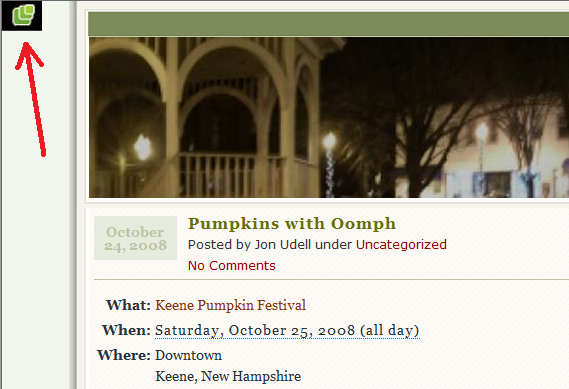
One aspect of the Oomph toolkit is an Internet Explorer extension that makes that embedded event come alive. Here’s what this page looks like in IE with the Oomph extension:


The arrow points to an indicator that “gleams” when a page contains microformatted elements.


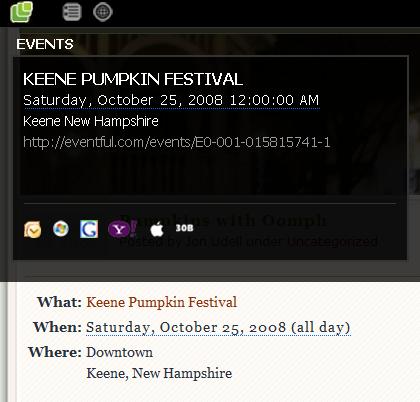
Clicking on the indicator opens a panel that activates them. In this case, the event is enhanced with icons for a variety of calendar import methods.


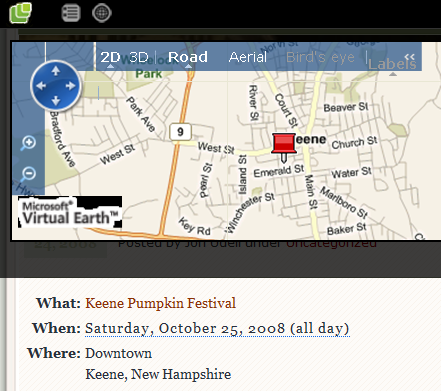
When an item has a location, you can map it:


If Oomph were only an IE-specific extension, I’d wouldn’t be writing about it. But in fact, it’s a cross-browser solution based on jQuery. I can’t demonstrate that here because WordPress.com blocks JavaScript, but consider these two pages:


1. Oomph: with explicit JavaScript. This page explicitly calls the Oomph JavaScript code, and works cross-browser. Try it!


2. Oomph: without explicit JavaScript: This page (like the blog entry you’re reading) does not uses the Oomph JavaScript code. The enhanced behavior is still available in IE, by way of the Oomph extension. It could also be available in Firefox, Safari, or Chrome if similarly extended.


It’s really helpful to have the option to go both ways: Server-side where it’s permitted, client-side where it isn’t.


There’s more to Oomph: CSS styles for microformats, and a Live Writer plug-in for inserting hCard (contact) elements into blog postings. You can get the toolkit and documentation on CodePlex. Nice work guys!


It's for a test: This post is crawled from http://blog.jonudell.net/2008/10/24/pumpkins-with-oomph/ (Fri Oct 24 14:14:57 2008).

Review: Prince of Persia: The Two Thrones game

Prince of Persia: The Two Thrones offers players a diverse gaming experience with challenging combat, stealth, and platforming elements. While the plot is forgettable and the graphics are dated, it still might be worth a look for those players looking for an old school gaming experience.


Add to digg

Add to Reddit

Add to Slashdot

Email this Article

Add to StumbleUpon


It's for a test: This post is crawled from http://rss.macworld.com/click.phdo?i=13a57e82faf49ed4908a438974e6d329 (Fri Oct 31 10:02:00 2008).

2008년 10월 2일 목요일

Mystery Crashed Plane?

English Russia recently published a report on a “crashed” plane in the Russian forest near St. Petersburg. The plane in question is an AN-8 light military transport aircraft of a type which was used by the Soviets up until the 1970s.


However on closer examination of the satellite shot, as well as the ground level pictures posted to English Russia, it looks that this plane is highly unlikely to have crashed!


Whilst it is sitting at the end of a paved clearing (which could maybe be a very short runway), the aircraft is facing the wrong direction to have simply overshot an attempted landing. Furthermore, the lack of damage to the exterior suggests it probably didn’t come down in the forest, as the trees would have torn at the wings.


Which leaves us with the question of who put this plane here, and why?


Locations: Russia / Categories:


View in Google Earth


You're reading an entry from Google Sightseeing, which is copyright © 2008 Alex Turnbull & James Turnbull and must not be reproduced without permission.


It's for a test: This post is crawled from http://googlesightseeing.com/2008/10/27/mystery-crashed-plane/ (Mon Oct 27 22:19:42 2008).